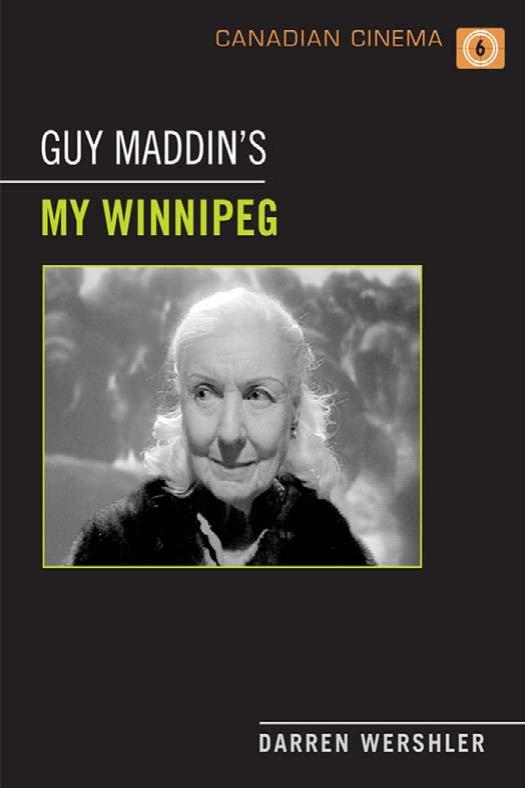
Guy Maddin's My Winnipeg by Darren Wershler
Author:Darren Wershler
Language: eng
Format: epub, pdf
Tags: PER004030
Publisher: University of Toronto Press, Scholarly Publishing Division
Published: 2010-09-04T04:00:00+00:00
Ann Savage, force of Nature (director’s caption). Courtesy of Guy Maddin, from the director’s personal collection.
The difference in time and place between My Winnipeg and the city symphonies of the 1920s and 1930s means that, despite Maddin’s employment of many of the genre’s conventions, the relative balance between pragmatic reality testing and fantasy has shifted. Where classic examples of the city symphony genre such as Berlin or Man with the Movie Camera consist largely of the believable, with the memorable enlisted to support it against incursions of the primitive, Maddin’s My Winnipeg dwells largely in memory and fantasy, with the believable playing a secondary role and traumatic moments of the primitive leaking out to a greater extent than in the majority of other city symphonies. Jim Hoberman writes, ‘Making his own detours, Maddin transforms Winnipeg into a city of mystery. No less than Feuillade’s Paris, this is a dream dump of labyrinthine alleyways, mysterious monuments, and peculiar landmarks.’30 In a city symphony made in the 1920s, melodrama might suddenly intrude in order to bring the implicit, imaginary subtext or dream logic to the surface.31 In My Winnipeg, we dwell in dream and melodrama and wonder constantly if the believable will even remain believable for long. In Maddin’s filmic world, it is often the fabrications that are most believable and the historical facts that seem preposterous.
As in examples of the city symphony from the 1920s, the structure of My Winnipeg is metonymic and associational rather than narrative. Like the giant Wolseley Elm growing out of the centre of a tiny circular boulevard in the middle of the Avenue, there are small islands of plot in My Winnipeg, connected by the meandering desires, recollections and daydreams of the director. ‘Stories about places,’ writes Michel de Certeau, ‘are makeshift things. They are composed of the world’s debris.’ Such stories, consisting of fragments of text tied to half-remembered family histories, urban legends, overheard conversations, personal anecdotes, and pillow talk, are articulated by their gaps as much as by their substance: ‘everywhere punched and torn open by ellipses, drifts, and leaks of meaning: it is a sieve-order.’32 For his part, Maddin says, ‘for months before I began filming My Winnipeg, I had a Post-It note on my fridge reading ‘More Ellipses.’33 In exchange for the certainties of plot, what such a structure affords are entrances and exits, the possibility of escape, and perhaps even of return, but always a trajectory towards a way of telling things that differs from the official one.
One route into a film that has no overarching plot to describe and no ‘round’ characters to analyse is to consider the route itself as part of a larger circulatory system. Both thematically and formally, My Winnipeg is a film that is deeply concerned with circulation from the first words of the narration – ‘All aboard!’ – onward.
On a thematic level, My Winnipeg concerns almost nothing but circulation. In an email to Andy Smetanka, Maddin describes the construction of a multi-purpose prop that drives
Download
This site does not store any files on its server. We only index and link to content provided by other sites. Please contact the content providers to delete copyright contents if any and email us, we'll remove relevant links or contents immediately.
The Great Music City by Andrea Baker(33609)
Aircraft Design of WWII: A Sketchbook by Lockheed Aircraft Corporation(32382)
Call Me by Your Name by André Aciman(20712)
The Secret History by Donna Tartt(19466)
The Art of Boudoir Photography: How to Create Stunning Photographs of Women by Christa Meola(18758)
Shoot Sexy by Ryan Armbrust(17852)
Plagued by Fire by Paul Hendrickson(17536)
Portrait Mastery in Black & White: Learn the Signature Style of a Legendary Photographer by Tim Kelly(17104)
Adobe Camera Raw For Digital Photographers Only by Rob Sheppard(17084)
Photographically Speaking: A Deeper Look at Creating Stronger Images (Eva Spring's Library) by David duChemin(16798)
Ready Player One by Cline Ernest(15139)
Pimp by Iceberg Slim(14791)
Bombshells: Glamour Girls of a Lifetime by Sullivan Steve(14217)
The Goal (Off-Campus #4) by Elle Kennedy(13963)
Art Nude Photography Explained: How to Photograph and Understand Great Art Nude Images by Simon Walden(13145)
Kathy Andrews Collection by Kathy Andrews(12087)
The Priory of the Orange Tree by Samantha Shannon(9359)
The remains of the day by Kazuo Ishiguro(9218)
Thirteen Reasons Why by Jay Asher(9117)
